I Didn’t Recognize My Body After Birth. And No One Prepared Me
No one truly prepares you for postpartum body changes.
You read about them. You hear about them. But until you look in the mirror after birth, especially after a C-section, you don’t fully understand what that means.
I remember standing in front of the mirror weeks after giving birth and thinking: Whose body is this?
And then feeling guilty for thinking that.
Postpartum Body Changes After a C-Section: What I Experienced
When you search for things like “postpartum body after C-section,” “C-section scar healing timeline,” or “why do I still look pregnant after giving birth?” you’re usually not looking for medical explanations. You’re looking for reassurance.
Here’s what mine looked like:
- A larger-than-expected C-section scar
- Swelling and tightness around the incision
- Persistent discomfort for several weeks
- Hormonal fluctuations
- Milk engorgement and blocked ducts
- Blood pressure monitoring after pregnancy complications
I had high blood pressure during pregnancy, which led to an emergency C-section. That pressure didn’t magically disappear after birth. I had to monitor it, take medication, attend follow-ups. All while caring for a premature newborn.
There’s something disorienting about healing physically while also being completely responsible for a tiny human.
The C-Section Scar: Healing Takes Time (Not Products)
My doctor recommended a scar cream during the first month. It was expensive. I applied it faithfully.
Did it work? Maybe a little.
But what truly worked was time.
The first month after a C-section is about internal healing, not cosmetic results. Your body has undergone major abdominal surgery. Layers of tissue are rebuilding. Nerves are recalibrating. Inflammation is slowly decreasing.
No cream can accelerate biology.
Over months, the scar softened. It faded slightly. It stopped feeling like a foreign line across my body and started feeling like part of my story.
Postpartum Body Image Is Not Just About Appearance
When we talk about postpartum body image, we often focus on weight or stretch marks. But for me, it wasn’t about weight at all.
It was about identity.
My body no longer felt like “mine.” It felt medical. Functional. Exhausted.
I was pumping every few hours. My breasts were constantly full, sore, sometimes blocked. I needed hot showers, warm compresses, massage – sometimes in the middle of the night. I was monitoring my blood pressure while trying to produce milk and care for a premature baby.
There was no space for vanity. But there was still emotion.
And that emotion deserves acknowledgment.
Why No One Talks Honestly About Postpartum Recovery
Postpartum recovery is often minimized.
You hear:
- “You’ll bounce back.”
- “At least the baby is healthy.”
- “It gets easier.”
And yes – the baby being healthy is everything.
But that doesn’t erase physical trauma.
Recovery after birth (especially surgical birth) includes:
- pelvic floor recovery
- abdominal muscle healing
- hormonal rebalancing
- emotional adjustment
- sleep deprivation
And yet you’re expected to function immediately.
When You Don’t Have Time to Think About Yourself
One strange thing about early motherhood: you don’t have time to analyze how you feel.
If there is no infection, no severe complication, no emergency – you keep going.
Your body hurts, but the baby cries.
You feel swollen, but it’s feeding time.
You feel fragile, but there’s a diaper to change.
That doesn’t mean your body isn’t healing.
It means motherhood temporarily overrides self-reflection.
Over time, though, I started to see my body differently.
Not as damaged.
Not as “ruined.”
But as resilient.
It carried life.
It survived surgery.
It produced milk for eight months.
It endured exhaustion.
That realization changed how I looked at my reflection.
Privacy & Image Disclaimer
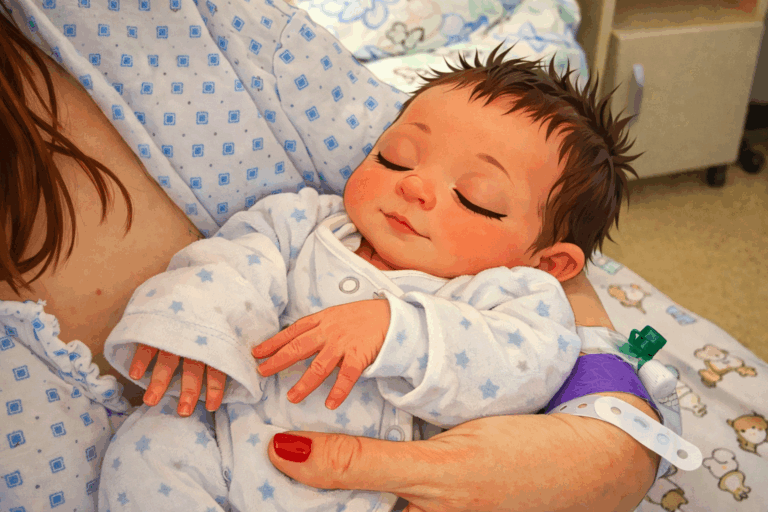
To protect our family’s privacy, all images on this blog are real-life moments, visually transformed into cartoon-style illustrations using AI. The stories are real. The emotions are real. The people are real. The art style is simply our way of keeping intimacy safe.