Starting Potty Time Before Walking: Why We Introduced the Potty at 6 Months
When Mike turned six months old, something shifted.
He wasn’t crawling yet. He definitely wasn’t walking.
But he could sit. Really sit. Steady, curious, alert.
And that’s when we introduced the potty.
Not because we expected miracles.
Not because we thought he’d suddenly “get it.”
But because, for us, it felt like the right moment to start familiarity, not training.
Is 6 Months Too Early to Introduce the Potty?
This is usually the first question people ask.
Short answer?
It depends what you mean by “introduce.”
We didn’t potty train at six months.
We didn’t expect signals, words, or results.
We simply created a routine and a safe space for awareness.
There’s a big difference between:
- potty training
- and potty familiarization
And that difference changes everything.
Potty Training vs Potty Familiarization
Potty training is outcome-focused.
Potty familiarization is process-focused.
Training says: “You should do this now.”
Familiarization says: “This exists. Let’s get comfortable with it.”
At six months:
- babies don’t understand cause and effect fully,
- they don’t control sphincters voluntarily,
- they don’t have language for bodily sensations.
Expecting results would have been unrealistic.
But building comfort? That felt possible.
What We Actually Did (No Pressure, No Expectations)
Our approach was simple and repetitive.
After every meal – solid or liquid – we placed Mike on the potty.
Not for long.
Usually 5 to 10 minutes.
We:
- played,
- read books,
- talked to him,
- sang,
- waited.
Sometimes something happened.
Sometimes nothing happened.
Both outcomes were fine.
We weren’t teaching him what to do.
We were teaching him where things can happen.
And slowly, without realizing it, the potty became familiar.
Why Sitting Was the Key Moment
For us, sitting well was the real signal.
Not age.
Not advice.
Not comparison.
Sitting meant:
- stability,
- safety,
- comfort,
- the ability to stay relaxed.
Trying earlier wouldn’t have made sense.
Waiting much longer wouldn’t have changed much either.
This wasn’t about being early.
It was about being aligned with his development.
What Early Potty Exposure Actually Helped With
Did he stop using diapers?
No.
Did he tell us when he needed to pee?
Absolutely not.
But it helped with something more subtle and also more important.
Body Awareness
Even before language, babies experience sensations.
They just don’t label them.
By repeating the routine, Mike slowly associated:
- certain sensations
- with a specific place
- and a calm, familiar context
No stress.
No pressure.
No disappointment.
Removing Fear
The potty wasn’t strange.
It wasn’t forced.
It wasn’t introduced during conflict or urgency.
By the time we truly needed it later, it wasn’t new.
What We Didn’t Do (On Purpose)
We didn’t:
- reward
- punish
- celebrate excessively
- react emotionally to success or failure
We didn’t turn it into a performance.
Because once pressure enters the picture, learning slows down.
Early Potty Introduction Isn’t About Results
It’s about:
- exposure
- routine
- trust
- patience
Six months wasn’t about “success.”
It was about planting a seed.
And that seed grew later – exactly when Mike was ready.
Privacy & Image Disclaimer
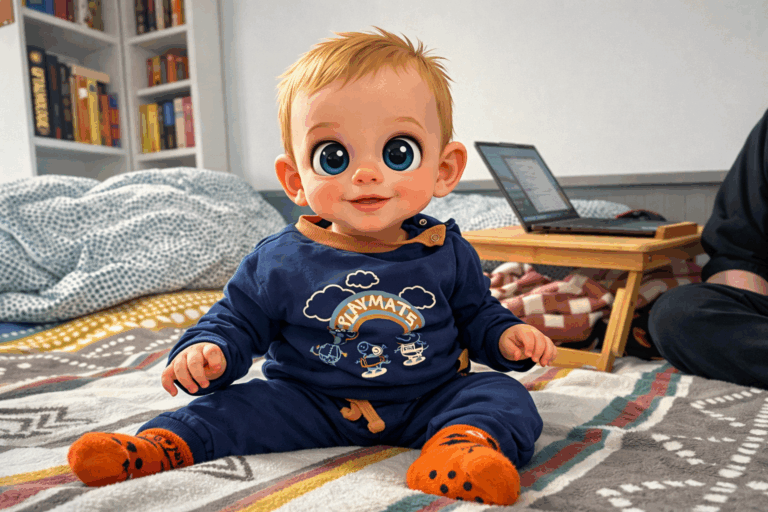
To protect our family’s privacy, all images on this blog are real-life moments, visually transformed into cartoon-style illustrations using AI. The stories are real. The emotions are real. The people are real. The art style is simply our way of keeping intimacy safe.