Screen Time for Toddlers: What We Allow, What We Don’t, and Why
Or, how we made peace with screens without letting them raise our child.
If you’re a parent in 2026, you’ve probably heard this sentence at least once:
“Screen time is bad for kids.”
And then, five minutes later, you’re Googling “Is it really that bad if my toddler watches cartoons?” while your child is already asking for “one more episode” 😅
So here’s our honest take – not from a parenting book, not from a perfect Instagram family – but from real life, with Mike.
We don’t ban screens.
We don’t use them as babysitters.
And we definitely don’t pretend they don’t exist.
We use them intentionally.
Our core rule: screens are a tool, not a replacement
From the moment Mike was born, we tried to ask ourselves one simple question over and over again:
“What does his brain and body actually need right now to grow healthy and happy?”
Not what’s convenient for us.
Not what society pushes.
Not what every other parent does.
Screens, like many modern inventions, can be useful, if they don’t replace what really matters: connection, play, presence, conversation.
So our rule became this:
Screens are allowed only if they don’t replace us.
How much screen time do we allow for our toddler?
Right now (almost 3 years old), Mike spends:
- ⏱ 30 minutes to maximum 1 hour per day
- 📺 usually one single moment, not spread all day
- 👨👩👦 rarely alone – at least one of us is there
When he was younger?
Much less.
And no, this wasn’t because we’re superheroes. It’s because we were present – and that changes everything.
What we allow (and why)
✅ Age-appropriate cartoons only
No fast-paced chaos, no overstimulation, no random autoplay rabbit holes.
We choose:
- simple stories,
- clear visuals,
- slow enough pacing,
- understandable language.
If we get a headache after 30 seconds, it’s a no 😄
✅ Screens as a shared experience
This is huge.
When Mike watches cartoons:
- we sit next to him,
- we talk about what’s happening,
- we ask questions,
- we name colors, objects, actions.
That’s how he:
- learned all colors in English (we’re from Romania, by the way),
- learned to count to 10 in English,
- picked up German words we didn’t even know ourselves 🤯
The screen didn’t teach him.
Interaction did.
✅ Technology as a learning bridge
We’ve used technology from early on, but intentionally.
For example:
- our Google Nest plays music (in English),
- Mike hears us talk to it daily,
- now he knows how to say “Hey Google”, “Stop”, and request songs.
Not because we trained him, but because he lives in a language-rich environment.
Technology didn’t replace communication.
It amplified it.
What we don’t allow (and why)
❌ Screens as background noise
TV on “just because” is a hard no.
Why?
Because kids don’t ignore it, even when they look like they do.
Their brains are constantly processing.
Silence, real sounds, conversations – those matter.
❌ Screens as emotional regulation
We don’t use cartoons to:
- stop crying,
- avoid tantrums,
- distract instead of explaining.
If Mike wants “one more episode”, we talk before pressing play:
- what will happen,
- how many episodes,
- when it ends.
Sometimes we even ask him to promise he won’t get upset when it ends.
And you know what?
Most of the time – he keeps his word.
Because he feels respected.
❌ Screens for parent “free time”
This one is uncomfortable but important.
We don’t give screens so we can disappear.
We give screens while staying present.
Is it tiring?
Yes.
Does it get easier?
Also yes.
Your brain adapts. Your routine adapts.
And one day, not doing it feels wrong – physically and mentally.
What we’ve noticed when screens are overused
On the rare days when Mike watches more than usual:
- he becomes disconnected,
- his attention drops,
- his reactions feel… muted.
Not dramatic. Not scary.
Just enough to remind us why limits exist.
So no, screens aren’t evil.
But too much, too fast, too often definitely isn’t neutral.
Our biggest takeaway as parents
Screen time isn’t about minutes.
It’s about:
- context,
- presence,
- intention.
A child doesn’t need zero screens.
A child needs engaged adults.
If you’re there – talking, explaining, laughing, connecting –
the screen becomes just another tool, not the main character.
And honestly?
That’s a compromise we can all live with ❤️
Privacy & Image Disclaimer
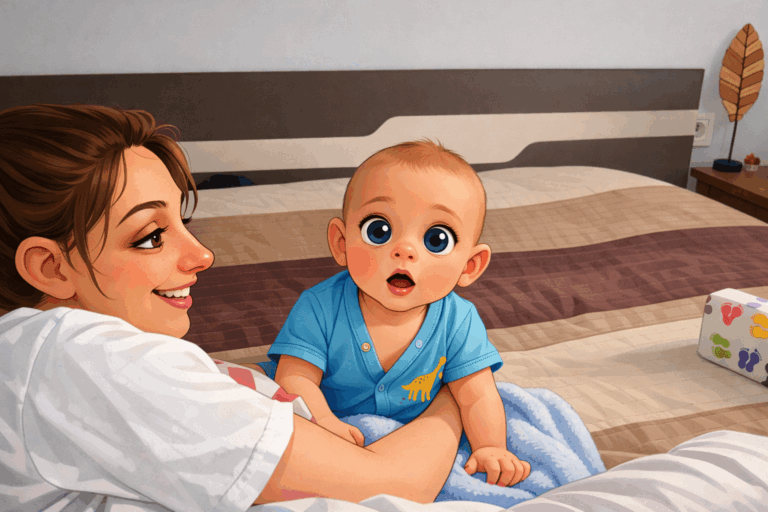
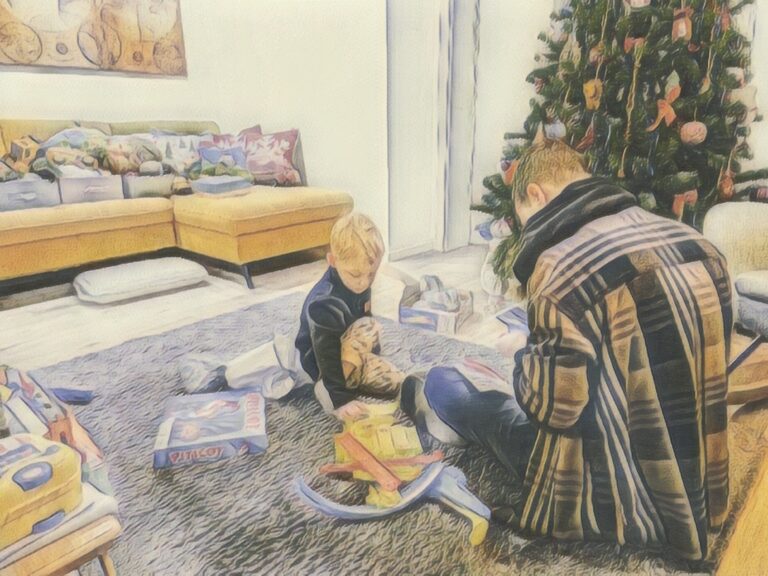
To protect our family’s privacy, all images on this blog are real-life moments, visually transformed into cartoon-style illustrations using AI. The stories are real. The emotions are real. The people are real. The art style is simply our way of keeping intimacy safe.